

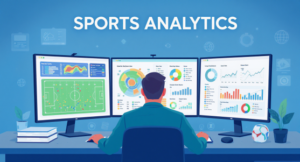
Sports are no longer decided purely by instinct or tradition. Today, the difference between winning and losing often comes down to data and the people who know how to use it. From analysing player movements to predicting game outcomes, sports analytics has become one of the fastest-growing career fields in the industry.
Ethan Hughes, an American sports analyst who has built predictive models for NFL outcomes and studied the impact of wearable tech on player performance, has seen this change up close. His work blends statistical modelling, performance tracking, and strategic insight, giving him a front-row seat to how analytics is reshaping modern sports. In this article, he explains what is driving this boom, the skills you need, and how to start a career in this exciting field.
Why Sports Analytics is Booming
The sports analytics market is expanding rapidly. According to MarketsandMarkets, it was valued at USD 3.78 billion in 2023 and is projected to reach USD 8.4 billion by 2028, growing at a compound annual growth rate (CAGR) of 17.8%.
Several factors are fueling this growth:
- Data Everywhere: Games are now tracked from every angle, from player speed and heart rate to ball trajectory.
- Wearable Tech: GPS trackers and biometric sensors provide real-time performance data.
- Advanced Software: Machine learning models predict injuries, evaluate tactics, and identify undervalued talent.
In professional football alone, analytics influences everything from draft picks to play-calling. Similar trends are visible in cricket, basketball, baseball, and even emerging sports markets like esports.
Skills You Need to Succeed
Breaking into sports analytics requires a mix of technical ability, sports knowledge, and communication skills.
Technical Skills: Proficiency in statistics, data analysis, and coding languages like Python or R is essential. Tools such as Tableau or Power BI are used to visualise insights for decision-makers.
Sports Knowledge: Understanding the rules, strategies, and culture of a sport is critical. Data means little without context.
Communication Skills: Analysts must explain complex insights clearly to coaches, players, or executives who may not be data experts.
Critical Thinking: The ability to interpret incomplete or noisy data and make sound recommendations.
Ethan often compares analytics to telling a story with numbers. The best analysts do not just crunch data, they make it actionable.
Career Paths in Sports Analytics
Career paths in sports analytics are diverse and can take professionals in several directions. Some work directly with professional or college sports teams, helping to improve performance and develop strategic plans. Others find their place in sports technology companies, creating and refining wearable devices, tracking systems, and analytical software. There are also opportunities in media and broadcasting, where analytics is used to enhance commentary and bring richer storytelling to fans. Another growing area is fantasy sports and fan engagement, where specialists build models that shape fantasy league recommendations and interactive content. While entry-level positions often focus on tasks such as data collection and cleaning, senior roles tend to involve strategic decision-making and the development of complex predictive models.
How to Get Started
You do not need to be a professional athlete or an experienced statistician to start a career in sports analytics. A strong foundation can come from studying subjects such as statistics, computer science, sports management, or data science. For those looking to learn independently, online platforms like Coursera, Udemy, and MIT OpenCourseWare offer courses that cover the basics of sports analytics. Building a portfolio is also important, and this can be done by analysing publicly available data from sources such as Kaggle, Pro-Football-Reference, or StatsBomb. Taking part in sports data hackathons or competitions, including the MIT Sloan Sports Analytics Conference, can provide valuable experience and visibility. Networking plays a key role as well, whether through joining LinkedIn groups, attending industry events, or contributing to online forums. Ethan himself began by creating small models for fantasy football leagues, and those early projects eventually became a central part of his professional portfolio.
The Role of Technology
Technology is at the heart of modern sports analytics, shaping how data is gathered, interpreted, and used. Wearable devices now monitor heart rate, speed, acceleration, and fatigue levels, giving teams real-time insight into player condition. Computer vision analyzes video footage to break down plays and evaluate positioning with remarkable accuracy. Predictive models go a step further, anticipating injuries, identifying rising talent, and forecasting game results. A clear example of this in action is the NFL’s Next Gen Stats platform, which uses RFID chips embedded in players’ shoulder pads to record position data ten times per second, producing a highly detailed map of movement on the field.
Challenges and Ethical Considerations
While the opportunities in sports analytics are enormous, they also bring important challenges. Player biometric data is extremely sensitive and must be handled with the highest standards of privacy. There is also the danger of over-reliance on numbers; analytics should enhance human judgment rather than replace it entirely. In addition, data can create new kinds of performance pressure, influencing contract negotiations and even career longevity in ways that may not always be fair. Ethan stresses that the most effective use of analytics is one that balances precision and empathy, respecting both the numbers and the people behind them.
Conclusion: Turning Passion into a Profession
Sports analytics is where love for the game meets analytical precision. The demand for skilled professionals will only grow as teams, broadcasters, and tech companies seek a competitive edge.
For those willing to develop the right skills, from coding to communication, and pair them with genuine sports knowledge, the opportunities are vast.
As Ethan puts it, success in sports analytics is about seeing the game through numbers without losing sight of the human story that makes sports worth watching.
About the Author
Ethan Hughes is an American sports analyst and writer with a strong background in data modelling, performance tracking, and sports technology. Over the past decade, he has built predictive models for NFL outcomes, explored the impact of wearable tech on athlete performance, and analysed how data shapes decision-making in modern sports. Known for explaining complex systems in clear, relatable language, Ethan blends his competitive drive with an analytical approach to help readers understand the fast-evolving world of sports analytics.