
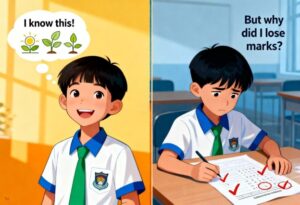
Mum, I knew the answer! I just didn’t know how to write it down properly.”
If you’ve heard this frustration from your child after a science test, you’re not alone. After teaching over 5,000 students, I’ve seen this scenario countless times. Your child understands photosynthesis. They can explain the water cycle during dinner conversations. Yet when exam papers come back, the marks don’t reflect what they actually know.
The problem isn’t your child’s intelligence or effort. It’s something far more fixable: they haven’t learned how to translate their understanding into the specific answering techniques and scientific keywords that PSLE markers are looking for.
The Gap Between Knowing and Scoring
Last month, a worried mother came to me with her Primary 5 daughter’s science paper. The girl had written, “Plants need sun to make food.” Technically correct, right? But she scored zero marks for a 4-mark question.
The expected answer? “Plants require light energy from the sun for photosynthesis to produce glucose (food) and oxygen.”
Notice the difference? Same concept, completely different execution. This gap costs students dozens of marks across a single PSLE science paper.
According to Singapore’s Ministry of Education, science assessment focuses heavily on students’ ability to apply scientific concepts and communicate their understanding using proper terminology. Yet most students spend their revision time memorizing facts without learning how to structure answers effectively.
Why Scientific Keywords Matter More Than You Think
When I simplified my teaching approach over the years, one pattern became crystal clear: students who master scientific keywords consistently outperform those who rely on everyday language, even when both groups understand the concepts equally well.
Here’s what happens during marking. PSLE markers work with detailed marking schemes that list specific keywords. If these exact terms don’t appear in your child’s answer, marks are deducted regardless of conceptual understanding.
Real-Life Example: Your child sees a bicycle rusting outside.
What they might write: “The bike got rusty because of water and air.”
What earns full marks: “Rusting is a chemical change where iron reacts with oxygen and water to form rust (iron oxide). This is an irreversible change.”
The second answer demonstrates precise scientific understanding through keyword usage. It signals to markers that your child hasn’t just observed the phenomenon but truly grasps the underlying scientific principles.
The Three-Part Framework That Transforms Exam Performance
Through working with thousands of families, I’ve developed a simplified framework that addresses exactly where students struggle. This approach forms the foundation of an effective PSLE Science tuition program and can be supported by parents at home too.
1. Keyword Identification and Application
First, students must recognize which scientific terms are essential for each topic. But here’s the catch – they also need to know when and how to use them correctly.
For instance, with forces:
- “Pull” becomes “pulling force” or “tension“
- “Push” becomes “pushing force” or “compression“
- “Weight” must specify “gravitational force acting on the object”
Parent Tip: When your child explains science concepts at home, gently remind them to use the proper scientific terms. Make it a fun game: “Can you tell me about your day using science keywords?” This builds natural usage without creating exam pressure.
2. Answer Structuring Techniques
PSLE science questions follow predictable patterns. Once students recognize these patterns, they can structure answers that markers reward.
For “Explain” questions (typically 3-4 marks):
- State what happens (the observation)
- Explain why it happens (the scientific principle)
- Use connecting words like “therefore,” “because,” “as a result”
- Include at least 2-3 keywords
Exam Smart: Questions beginning with “Explain why…” require cause-and-effect relationships, not just descriptions. Students who understand this distinction immediately write more complete answers.
3. Real-Life Connection Practice
The questions students struggle with most are those requiring application to unfamiliar contexts. This is where daily life becomes your greatest teaching tool.
When cooking together: “Why does the pot handle heat up?” (thermal energy transfer through conduction)
During grocery shopping: “Why are frozen vegetables stored in sealed plastic?” (prevents water loss through evaporation, maintains freshness)
At the playground: “Why is it harder to pull the swing back at first?” (overcoming friction and initial inertia)
These conversations build the mental flexibility PSLE science demands without feeling like study time.
The Open-Ended Question Challenge
Many parents tell me that open-ended questions are where their children lose the most marks. These questions typically carry 4-6 marks and require students to demonstrate deeper thinking and comprehensive responses.
The secret? These questions are actually testing the same skills in combination:
- Keyword usage
- Structured explanation
- Concept application
- Complete reasoning chains
When students have practiced these elements separately, open-ended questions become far less intimidating.
Common Mistake to Avoid: Students often write everything they know about a topic rather than answering the specific question asked. Teaching them to underline key phrases in the question and check their answer against these phrases makes an enormous difference.
Building Confidence Through Consistent Practice
Science confidence doesn’t come from memorizing textbooks. It develops when students repeatedly experience the satisfaction of translating their understanding into marks on paper.
This requires strategic practice:
- Start with topic-focused questions before attempting full papers
- Review not just wrong answers but marks lost on partially correct ones
- Practice writing answers within time limits
- Compare student answers with marking scheme answers to identify gaps
Parent Tip: You don’t need to be a science expert to help your child. Simply ask them to explain their answers to you using scientific keywords. If they can teach it clearly, they usually understand it well enough for exams.
The MOE Syllabus Reality Check
Singapore’s science curriculum is comprehensive, covering everything from diversity of living things to forces and energy systems. The PSLE examination format tests application and analysis, not just recall.
What this means practically: Your child needs to move beyond “what” and “where” to tackle “why” and “how.” This deeper understanding only develops through guided practice with proper answering frameworks.
The schools do excellent work introducing concepts, but the jump to exam-level application often happens too quickly for many students. This is where focused support – whether through an effective PSLE Science tuition program or structured home revision – makes the crucial difference.
Moving Forward: What Your Child Actually Needs
Looking ahead to PSLE, your child doesn’t need to know more science facts. They need to master communicating what they already know in ways that earn marks.
This transformation happens through:
- Systematic keyword learning – not random memorization but understanding which terms matter for each concept
- Answering technique practice – structured approaches to different question types
- Regular application exercises – connecting classroom learning to real-world scenarios
- Immediate feedback loops – knowing what works and adjusting quickly
The beautiful part? Once these skills click, students often find science becoming one of their stronger subjects. The concepts make sense, the questions become predictable, and the confidence transforms their entire approach.
Your Role in Their Science Success
As parents, we sometimes feel helpless watching our children struggle with science. We remember our own PSLE stress, and we worry about their future academic paths being determined by these crucial exams.
But here’s the encouraging truth: you can make a significant difference without being a science expert yourself. By reinforcing proper keyword usage at home, encouraging structured thinking, and connecting science to daily experiences, you become an essential part of your child’s success story.
Whether your child is currently scoring AL3 and aiming for AL1, or struggling to grasp basic concepts, the pathway to improvement follows the same principles. Break down the complexity. Master the keywords. Practice the techniques. Apply to real life. Repeat.
Every child I’ve taught who consistently followed this approach has seen measurable improvement. Not because they suddenly became “better at science,” but because they learned to demonstrate what they knew in ways that PSLE markers could reward.
Your child’s next science breakthrough might be closer than you think. Sometimes it’s not about learning more – it’s about learning how to show what they already know.