

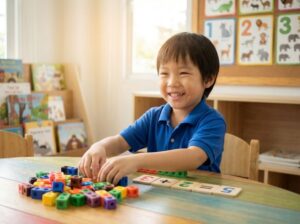
Your child’s first year in primary school looks innocent enough. Simple counting, basic addition, maybe some shapes and patterns. Nothing too complicated, right? But here’s what most parents don’t realise until much later: Primary 1 isn’t just about learning to count to 100. It’s the year your child’s entire relationship with mathematics gets established.
Think about the adults you know who say “I’m just not a math person.” Nine times out of ten, that belief took root somewhere in their early primary years. They hit a bump, didn’t get the support they needed, and decided maths wasn’t for them. That’s a door closing on countless future opportunities, all because of what happened (or didn’t happen) when they were six or seven years old.
What P1 Math Actually Teaches
Primary 1 math covers way more than basic arithmetic. Yes, your child learns numbers up to 100, simple addition and subtraction, and how to recognise shapes. But underneath all that, something much more valuable is happening.
They’re learning to see patterns. To break problems into smaller pieces. To think logically about how things connect. These aren’t just “math skills.” They’re fundamental thinking skills that show up everywhere, from planning their school day to figuring out how to build something with blocks to eventually managing projects and solving complex problems in their careers.
Research from the National Association for the Education of Young Children shows that early mathematical thinking predicts later academic success better than early reading skills. That’s not to say reading doesn’t matter (it absolutely does), but it highlights just how foundational these early math concepts are.
The Confidence Window
Here’s something interesting about six and seven year olds. They haven’t yet developed that fixed mindset about their abilities. A P1 student who struggles with something today will happily try again tomorrow. They’re naturally resilient.
But this window doesn’t stay open forever. By P3 or P4, many children have already decided whether they’re “good at math” or not. Once that belief sets in, it becomes really hard to shift. That’s why P1 matters so much. It’s your best chance to help your child build genuine confidence with numbers before any negative beliefs take root.
Common Struggles Parents Miss
Most P1 math problems don’t look like problems at first. Your child might be getting their sums right but not really understanding what addition means. They might memorise that 3+4=7 without grasping that it means combining groups or moving forward on a number line.
This happens all the time. A child learns to get correct answers through pattern recognition or memorisation, but the conceptual understanding isn’t there. Then suddenly in P2 or P3, when the problems get more complex, everything falls apart. The foundation was shaky from the start, but nobody noticed because the test scores looked fine.
Watch out for these signs. Does your child solve problems the long way when shortcuts exist? Do they struggle to explain their thinking? Can they only work through problems in one specific way? These might indicate gaps in understanding that will cause trouble later.
Number Sense: The Skill Nobody Talks About
There’s this thing called number sense. It’s hard to define precisely, but you know it when you see it. A child with good number sense understands that 47 is close to 50, that 99+2 is easier if you think of it as 100+1, that 8+7 connects to 8+8 which they might already know.
Number sense isn’t taught directly in most classrooms. It develops through lots of varied experiences with numbers and through conversations about mathematical thinking. Children who develop strong number sense in P1 and P2 find later math so much easier because they’re not just following rules. They actually understand what numbers mean and how they behave.
You can build this at home through everyday activities. Cooking together involves measuring and fractions. Shopping involves addition and money. Even simple card games teach number comparison and basic strategy. The key is talking about the math you’re doing instead of just doing it silently.
When Early Support Makes the Difference
Some children sail through P1 math without any issues. Others need a bit more time or a different approach to grasp certain concepts. There’s nothing wrong with either situation. What matters is recognising where your child is and making sure they get what they need.
According to research published by Cambridge University Press, early intervention in mathematics has significantly better outcomes than waiting until problems become obvious. A child who gets support in P1 or P2 catches up much faster than one who struggles through several years before anyone addresses the gaps.
If you’re noticing your P1 child getting frustrated with homework, avoiding math activities, or consistently making the same types of mistakes, that’s worth paying attention to. Early support through quality programmes like Math tuition for primary 1 can help fill those gaps before they become bigger problems. The right guidance at this stage builds both skills and confidence.
Beyond School Math
The skills your child develops through P1 math extend way beyond getting good grades. Mathematical thinking shows up in unexpected places throughout life.
Planning a birthday party? That’s budgeting, scheduling, and proportional thinking. Learning a musical instrument? Pattern recognition and sequential thinking. Playing sports? Spatial awareness and quick mental calculations. Eventually in their career, whatever field they choose, they’ll use logical thinking, problem-solving, and analytical skills that have their roots in early mathematical learning.
We’re not trying to turn every six year old into a mathematician. But we are trying to equip them with thinking tools they’ll use constantly throughout their education and career. That’s why these early years matter so much.
Creating a Math-Positive Home
Your own feelings about math will influence your child whether you realise it or not. If you say things like “I was never good at math either” or “math is hard,” your child absorbs that message. They might decide it’s okay to give up or that struggling with math is just how things are.
Instead, try framing challenges as normal parts of learning. “This is tricky, but let’s figure it out together.” “Making mistakes helps our brain grow.” “You couldn’t do this last week, and now you can!” These messages build what researchers call a growth mindset, the belief that abilities develop through effort.
Make math visible in daily life. Point out numbers everywhere. Compare prices at the supermarket. Talk about how far away places are. Play board games that involve counting and strategy. When your child sees math as something useful and normal rather than just school subjects, their attitude shifts completely.
The Long Game
Primary 1 feels like just the beginning, and it is. But it’s also the year that shapes everything coming after it. The confidence your child builds now, the understanding of basic concepts, the belief that they can figure things out… all of that carries forward.
Children who finish P1 with solid foundations and positive attitudes toward math have smoother journeys through the rest of primary school. They’re not playing catch-up. They’re not fighting against negative beliefs about their abilities. They’re building on strength rather than trying to fix weakness.
That’s not to say everything will be perfect. Every child hits bumps along the way. But starting from a position of confidence and understanding makes those bumps much easier to handle.
Making It Happen
So what do you actually do with all this information? Start by paying attention to how your child talks about and approaches math. Listen for signs of struggle or frustration. Notice what they find easy and what makes them hesitate.
Talk to their teacher regularly. Ask not just about grades but about understanding. Does your child grasp the concepts or are they just memorising procedures? Can they explain their thinking? Do they approach problems confidently?
Provide support early if you spot gaps. This might mean spending extra time at home working through concepts, finding educational games that make practice fun, or getting professional help from tutors who specialise in early primary math. The investment now pays off for years to come.
Final Thoughts
Your P1 child is building something important this year, even if it doesn’t always look dramatic. They’re developing not just math skills but thinking skills. Not just knowledge but confidence. Not just answers but understanding.
Pay attention to this foundation year. Support your child through the challenges. Celebrate the progress. And remember that what looks like simple primary school math today is actually preparing your child for a lifetime of problem-solving, logical thinking, and confident learning.
The skills they build now will serve them in ways you might not even imagine yet. That’s what makes Primary 1 such a crucial year, and that’s why it deserves your attention and support.