
Union Ministry of Education today released the Reports of the All India Survey on Higher Education (AISHE) for the years 2022-23 and 2023-24. The AISHE collects detailed information from Higher Education Institutions (HEIs) across the country through a web-based Data Capture Format (DCF). Institutions upload data on student enrolment, faculty and staff, infrastructure, examination results etc. on the AISHE portal. AISHE serves as the primary source of official statistics on higher education in India and provides critical insights for policy formulation, planning, and monitoring of the sector.
The HEIs exhibited strong participation in the AISHE during both the years. The participation of HEIs in 2022-23 was 56,180 out of 60,380 HEIs registered and 59,533 out of 64,756 registered HEIs in 2023-24. For both the surveys, the participation rate is more than 90%.
Key Highlights of the Surveys:
Gross Enrolment Ratio (GER)
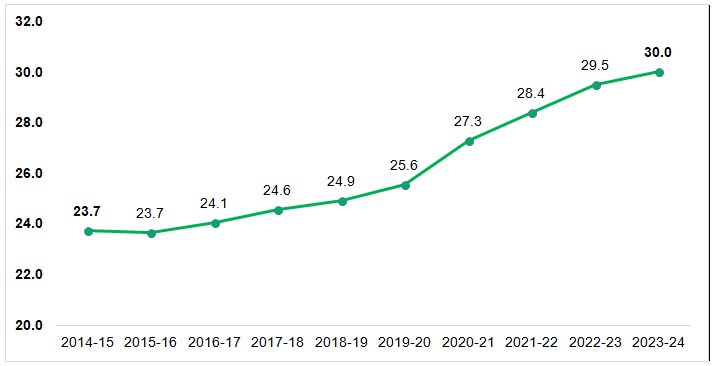
- The Gross Enrolment Ratio (GER) is computed as the ratio of student enrolment to total population in the age group of 18-23 years based on 2011 population projection. The GER, which was 23.7 in 2014-15 has been continuously increasing and reached 29.5 in 2022-23 and 30 in 2023-24. Female GER has risen to 31.2 in 2023-24 from 30.2 in 2022-23 and 22.9 in 2014-15.
GER trend during last decade
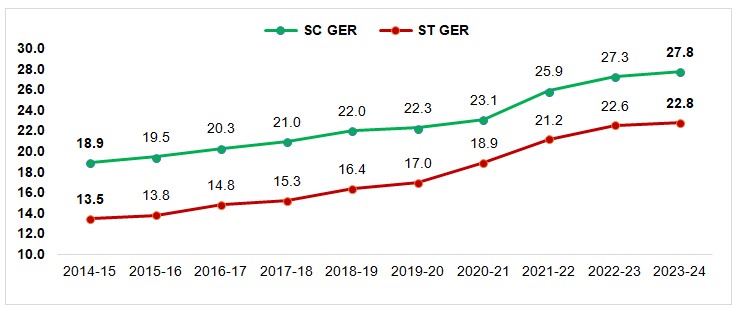
- The GER of Scheduled Castes (SC) students have increased to 27.8 in 2023-24 from 18.9 in 2014-15. The GER of Scheduled Tribes (ST) students have increased to 22.8 in 2023-24 from 13.5 in 2014-15.
GER trend for SC and ST students during last decade
Gender Parity Index (GPI)
- The ratio of female GER to male GER is computed as the Gender Parity Index (GPI) which measures the relative access to education of males and females. The GPI for 2023-24 stands at 1.08. The GPI has remained above 1.0 for seven consecutive years, indicating consistently higher female participation in the higher education.
Enrolment
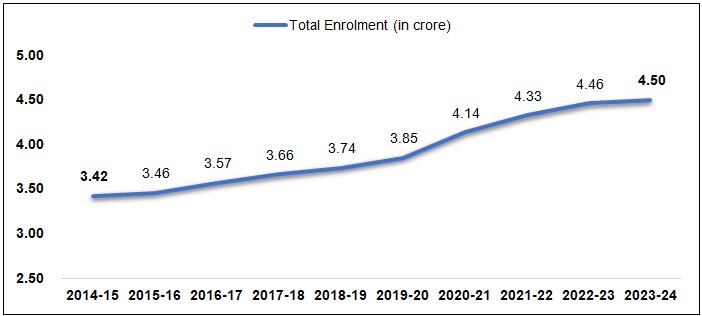
- The enrolment in higher education has been continuously increasing from 3.42 crore in 2014-15 to 4.46 crore in 2022-23 and 4.50 crore in 2023-24 (i.e. 31.5% increase since 2014-15). In fact, there was commendable increase in female enrolment in higher education from 1.57 crore in 2014-15 to 2.18 crore in 2022-23 and 2.24 crore in 2023-24 (i.e. 42.2% increase since 2014-15).
Enrolment trend during last decade
Growth in enrolment during last decade
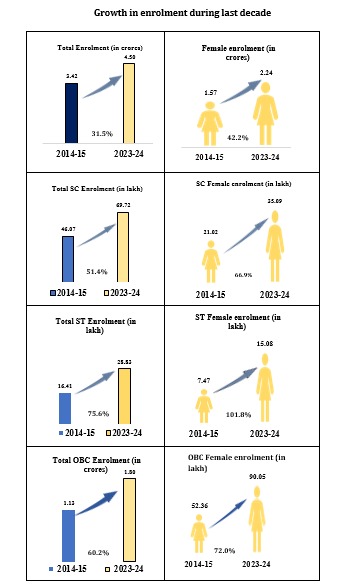
- The enrolment of SC students has increased to 69.72 lakh in 2023-24 from 46.07 lakh in 2014-15 (an increase of 51.4% since 2014-15). The enrolment of ST students has increased to 28.83 lakh in 2023-24 from 16.41 lakh in 2014-15 (an increase of 75.7% since 2014-15). Similarly, the enrolment of Other Backward Classes (OBC) students has increased to 1.80 crore in 2023-24 from 1.13 crore in 2014-15 (60.2% increase).
STEM enrolment
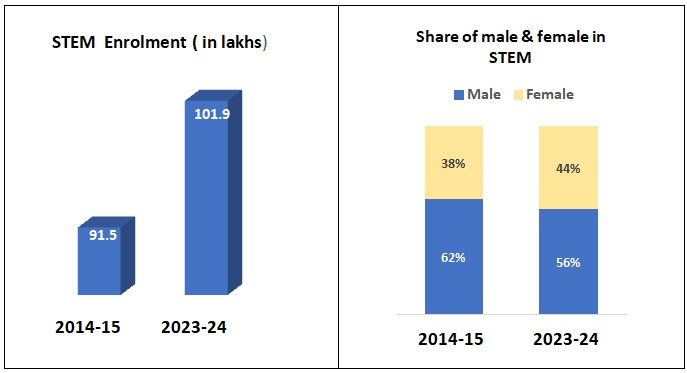
- STEM enrolment has risen significantly over the past decade, from 91.5 lakh in 2014-15 to 1.02 crore in 2023-24, reflecting the growing emphasis on science, technology, engineering, and mathematics education in the country.
- The share of female students in STEM enrolment has also shown a steady improvement over the years, rising from 38.4% in 2014-15 to 44% in 2023-24, reflecting growing gender inclusivity in science, technology, engineering, and mathematics education in the country.
- The total number of faculty/teachers increased to 17.32 lakh in 2023-24, of which 55.1% are male and 44.9% are female. The female faculty strength has increased from 5.69 lakh in 2014-15 to 7.37 lakh in 2022-23 and further to 7.78 lakh in 2023-24.
Survey Note
Participation in AISHE is voluntary, and the data is self-reported by the HEIs via AISHE web portal. Though the Ministry does the due diligence, through inbuilt validations and scrutiny checks, the quality of data is generally taken care of by the respective HEIs. Moreover, AISHE being a survey, any limitations inherent to large scale surveys might affect the outcome of the AISHE slightly.
The detailed report is available at the following link:
https://www.dohe-education.gov.in/documents/reports/aishe-report-MzN1EjMtQWa?pageTitle=AISHE-Report